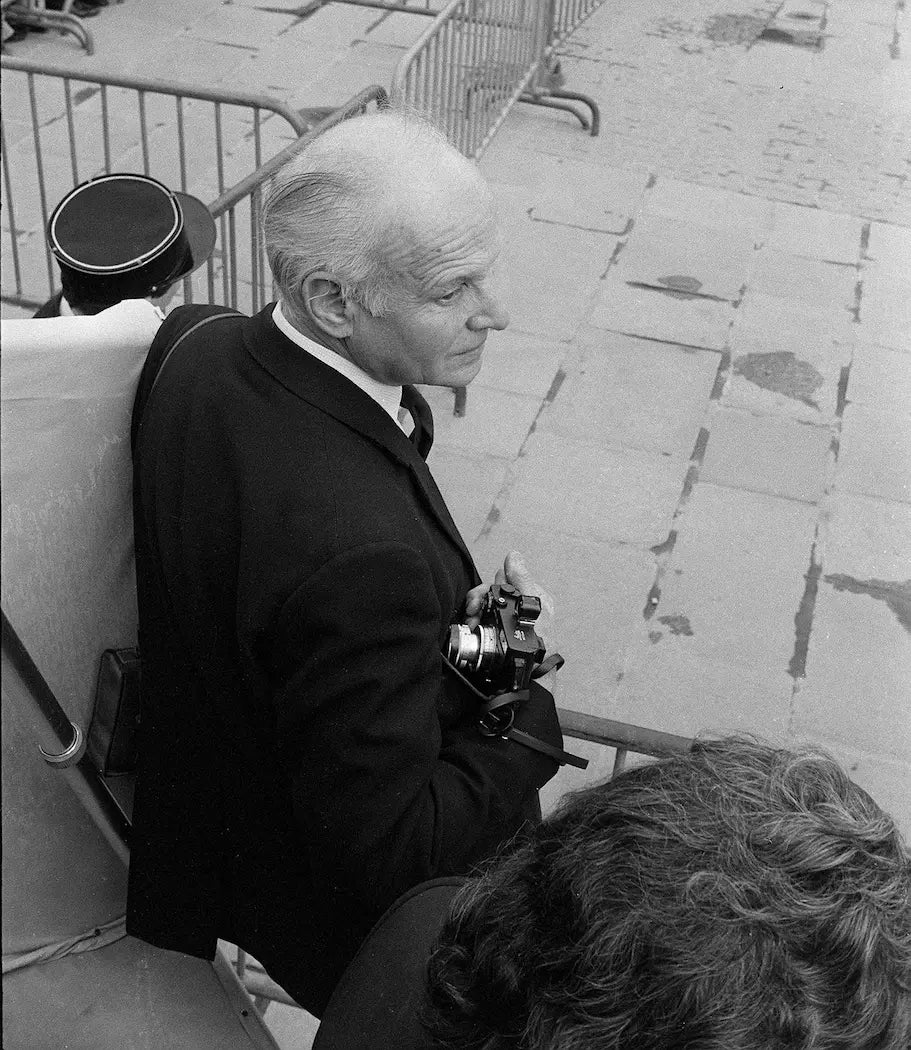
1. Practice Extreme Patience
Patience is central to Cartier-Bresson’s work, yet it is often misunderstood. Waiting for hours in a single spot was not laziness, but a methodical act of attentiveness and a way to let life reveal its own rhythms. In our modern age of rapid capture and digital immediacy, this approach can seem boring and almost radical. Yet, it is precisely through patience that he was able to capture the “decisive moment”; when the chaos of life quietly aligns into a visually and emotionally coherent image.
Cartier-Bresson demonstrates that patience is intertwined with observation. The photographer’s task is not to always stage or manipulate life into a preconceived vision. Instead, the goal should be to cultivate attentiveness by allowing events, gestures and human interactions to naturally unfold. By observing patiently and positioning oneself within the flow of reality, the photographer can recognize alignments of shapes, light and meaning that might otherwise go unnoticed.

2. Compose Instinctively, Not Mechanically
Cartier-Bresson began photographing in 1931, particularly inspired by Cubism and Surrealism. These early influences can be seen in his bold use of collage-like compositions and his unconventional use of framing. The streets and alleys of his immediate surroundings became a lab where he experimented with perspective, form and rhythm long before he became the narrator of global events.
This early experimentation reveals a critical lesson: Cartier-Bresson’s mastery did not emerge from technical skills alone, but from a cultivated curiosity about the visual possibilities of the world around him. One of Cartier-Bresson’s signature achievements is the compositional balance of his photographs, and while many focus on the clear perfection of his images, fewer appreciate that this was often the product of a sustained practice and attention to the world around him. He sometimes shot without even looking through the viewfinder, relying on an internalised sense of rhythm and spatial harmony. This instinct was cultivated over decades of rigorous observation and experimentation.

3. Travel Light and Remain Invisible
Cartier-Bresson discovered the Leica 35mm camera in 1932, and for the rest of his life, he worked almost exclusively with a 50mm lens. This simplicity allowed him to move fluidly among his subjects and respond to fleeting moments with discretion. The 50mm lens, which almost resembles human vision, compelled him to engage directly with his environment rather than manipulating it from a distance.
His insistence on natural light and avoidance of flash, calling it impolite, further emphasises his philosophy of invisibility. He compared the use of flash to the act of attending a concert with a pistol (bizarre, we know), and believed that intrusive lighting disrupted the authenticity of a moment. Cartier-Bresson’s best images emerged when he was fully present, but still unseen. The lesson to be learned brings us back to that mastery often comes not from technical complexity. By limiting tools and embracing simplicity, you train the eye to anticipate situations and interactions. The true photographic power doesn't always come from the sophistication of a photographer’s equipment.

4. Your Most Important Lens Is Your Mind
Cartier-Bresson famously said that photographs are not made with the camera, but with the eye, heart and mind. While his technical choices were simple, his intellectual engagement with photography was profound.
He treated each photograph as both an act of observation and an exercise in visual thinking, and his approach challenges modern photographers to engage with their surroundings not only physically, but also mentally and emotionally. Many photographers assume that simply being present in a scene is enough, yet to truly consider composition, timing and the subtle interplay of human gestures, one must be fully attentive to the structure of the space, the relationships between forms, and the rhythms of life as they unfold. Cartier-Bresson demonstrated that this requires a complete engagement of eye, mind and heart, a commitment to feeling connected to the scene as much emotionally as intellectually.

5. Capturing the Decisive Moment
The decisive moment, defined as the fleeting instant when the meaning of an event and the composition of forms converge, is Cartier-Bresson’s long-lasting gift to photography. It is not just about capturing a visually appealing image, but about recognising and conveying the essence of a lived moment in real time. Achieving this requires a combination of patience, intuition and a deep understanding of human behavior. There is plenty to learn from Cartier-Bresson’s obsession with the integrity of the photographic vision that begins and ends with the press of the shutter.
Contrary to popular belief, Cartier-Bresson was not a purist in the sense of refusing any post-production. Instead, his philosophy emphasised that the power of a photograph lies in seeing, sensing and composing in real time, rather than relying on darkroom manipulation or technological intervention to fix it. Even in his most celebrated images, Cartier-Bresson sometimes made minor adjustments, yet these never compromised the essence of the decisive moment. A well-known example is Behind the Gare Saint-Lazare, where a wooden fence was obstructing the left of the frame, thus requiring slight cropping for clarity. Despite this small modification, the composition and the extraordinary timing of the man’s leap remain intact.

For Cartier-Bresson, the photograph existed first and foremost in the moment he framed it through his viewfinder. He said that any subsequent adjustments were merely finishing touches.
Henri Cartier-Bresson’s influence extends across generations of photographers. Not only in the techniques he pioneered, but in the way he demonstrated that vision, curiosity and presence are more important than the latest equipment. His work makes us reconsider photography as a mode of thinking, seeing and being in the world. His combination of patience, intuition, compositional mastery and philosophical insight sets him apart. He teaches us that the true power of photography lies in the ability to recognize life’s patterns, respond to them with sensitivity and care, and to preserve moments of fleeting yet profound meaning.

%20remains%20one%20of%20the%20most%20influential%20figures%20in%20the%20...)