When analysing the photographic gaze more closely, it is helpful to consider three interrelated perspectives. The first is the sitter’s gaze, which concerns where the subject is looking and how they appear within the frame. A direct gaze may suggest confidence or confrontation, while an averted gaze can imply detachment or unawareness. The second is the artist’s gaze, shaped by how the photographer perceives the subject and how they intend the viewer to perceive them in turn. Choices of framing, distance and timing all carry interpretive weight. The third perspective is the viewer’s gaze. As viewers, we do not merely receive information from an image, but actively participate in its meaning. How we look at the subject, whether we return their gaze or consume the image passively, completes the ethical circuit initiated by the camera.
Historically, both artists and viewers were predominantly men, a fact that profoundly influenced how women were depicted and understood in visual culture. Women were often positioned as objects to be looked at rather than as subjects with agency, their appearance filtered through ideals shaped by male desire and authority. This imbalance contributed to a tradition in which women were seen far more often than they were allowed to see, reinforcing broader structures of gendered power that extended well beyond the photographic frame.

Prince Street Girls by Susan Meiselas
The Camera as a Controlling Gaze
Many people have experienced the discomfort of not wanting their photograph taken, an unease that reveals how deeply photography is bound up with control. To photograph someone is to exert temporary authority over their appearance, an authority that extends beyond the moment of exposure and includes all future viewers of the image.
Susan Sontag’s reflections in On Photography remain foundational in understanding this dynamic. She famously argued that to photograph is to appropriate the thing photographed, transforming a person or event into an object that can be possessed and circulated. Photography, she noted, is rarely a neutral act of observation. It is often an act of non intervention that nevertheless encourages situations to persist, aligning photographic seeing with voyeurism rather than engagement. While the camera does not physically violate its subjects, Sontag emphasised that it can intrude, trespass, distort and exploit, all while maintaining a sense of distance that disguises its impact.
These concerns also resonate with Michel Foucault’s analysis of surveillance and power in modern society. Foucault described what he called the normalising gaze, a way of seeing in which visibility itself becomes a form of control. To be seen is not simply to be noticed, but to be assessed, compared and judged against shared ideas of what is considered normal or acceptable. Photography participates in this process by making people visible in ways that invite evaluation, whether consciously or not. While Foucault initially identified this dynamic within institutional settings such as prisons, schools and hospitals, the same logic now operates far more broadly. Extending into everyday life and digital platforms where images are constantly produced and scrutinised, it becomes clear that ethical responsibility no longer belongs solely to authorities or professionals. It applies equally to street photographers, documentary photographers and everyday image makers who contribute, even unintentionally, to systems of visibility and judgment.

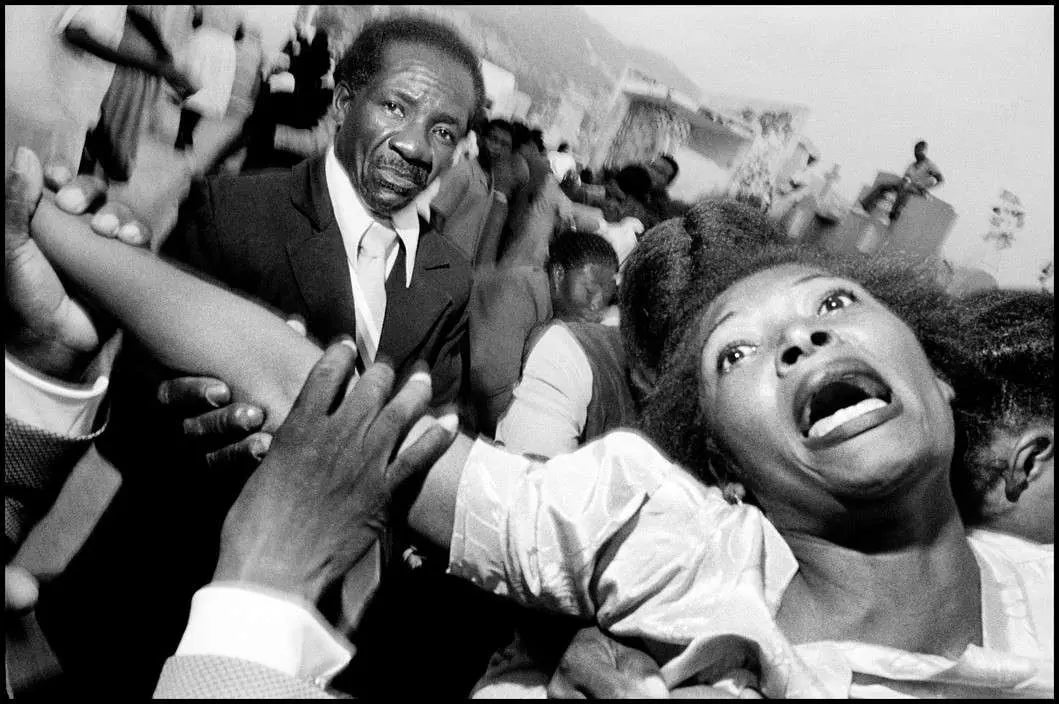
By Bruce Gilden
Uninvited Participants and the Ethics of Presence
When viewing a photograph that includes people, attention often stops at counting the visible figures within the frame. Yet many images contain more presences than are immediately apparent. Consider an image from Alex Webb’s series Mound Bayou (see below). While one might initially identify three people in the photograph, there is also a fourth presence, the photographer. Though physically absent from the image, the photographer is an uninvited participant whose presence is felt through composition and timing. Asking for explicit consent at the moment would likely have disrupted the very spontaneity that gives the photograph its vitality. There is also a fifth presence, the viewer. Arriving after the fact, the viewer nevertheless intrudes upon a moment that was not intended for them. The presence of these unseen guests forces us to ask whether those observing or capturing the moment occupy a morally defensible position in relation to the subjects depicted, and to what extent responsibility accompanies the act of looking.
Street photography exists precisely at the crossroads of creativity, privacy and ethics. Its appeal lies in its immediacy, in the sense that we are witnessing something unfiltered and unperformed. Posed and consensual images can be powerful and accomplished, yet they rarely produce the same visceral response as a candid photograph. As viewers, we often feel immersed because the subjects do not acknowledge our presence. They do not meet our gaze or disrupt the illusion of access, and this grants what might be described as a license to witness without participation.

Mound Bayou by Alex Webb
Witnessing Without Responsibility
The notion of a license to witness without participation captures a central ethical tension in photography. The camera grants both photographer and viewer an unearned right to observe significant and sometimes deeply private or traumatic moments from a distance, without bearing responsibility for what is seen. The physical act of holding a camera creates a barrier that enables detachment, allowing observation to replace engagement.
Diane Arbus’s work exemplifies the discomfort embedded in this form of witnessing. Early in her career, Arbus reportedly used the camera as a means of overcoming personal shyness, allowing her to approach subjects she might otherwise have avoided. Her photographs often depict marginalised individuals staring directly into the lens, confronting the viewer with an unsettling intensity. Sontag criticized Arbus for encouraging her subjects to pose in ways that exaggerated their otherness, producing images that verge on caricature rather than understanding. The American author Jack Halberstam echoed this critique, describing her as a “solipsistic voyeur who rendered her subjects strange and distorted”. Whether one agrees with these assessments or not, Arbus’s work underscores how easily the ethical boundary between revelation and exploitation can become unstable.
The fact that celebrated figures such as Henri Cartier Bresson, Robert Frank, William Klein, Vivian Maier and Arbus herself all practiced forms of candid photography does not resolve this dilemma. Artistic recognition does not retroactively validate ethical ambiguity, nor does it mean that these photographers didn’t reflected on the moral implications of their methods.

By Diane Arbus
Law, Ethics and Responsibility
It is often argued that public space is inherently public and in many jurisdictions this is legally true. In the United States, photographing individuals in public without consent is generally lawful, with a few exceptions. In other countries like France, it may be legal to take these photographs, but sharing or publishing them is often strictly controlled. Yet legality is not the primary concern here as the absence of legal restriction does not guarantee the absence of harm. Ethics operates precisely where law falls short, asking not whether a photograph can be taken, but instead whether it should be.
Holding a camera confers power. The photographer decides which moments are preserved, which faces become visible and which narratives are reinforced or silenced. In documentary contexts, this power carries particular weight. When photographing vulnerable populations, choices of framing and context can either humanise or exploit. Ethical practice requires asking who benefits from an image, whether it contributes to understanding or whether it merely aestheticises vulnerability.
Cultural context further complicates these questions. In some societies, particularly in parts of the Middle East and Africa, photography carries spiritual or symbolic significance. In certain communities, capturing a person’s image is believed to affect their soul, spirit or social status, and photographing without permission may be considered a violation of religious beliefs. Therefore, pointing a camera without permission can be deeply disrespectful, and ethical engagement in such contexts demands research and a willingness to collaborate. Rather than taking images, photographers are called to create them in dialogue with those represented. This means actively involving the subjects in the process, listening to their perspectives, understanding what they are comfortable sharing and sometimes even allowing them to shape how they are portrayed.

By Vivian Maier
Toward an Ethical Street Practice
Even with the best intentions, misunderstandings are inevitable in street photography. While it may be tempting to assert legal rights when challenged, ethical practice is not about winning arguments, but about maintaining mutual respect. Street photography thrives on unpredictability, yet respecting boundaries does not require sacrificing creativity.
Vivian Maier’s work offers a compelling example of how observation can coexist with dignity. She captured people in unguarded, authentic moments, revealing deep emotion with compassion and her presence never felt intrusive. Her self-portraits, often seen in reflections while other people remain the main focus, subtly revealed her hidden presence and duality, which adds another layer to her candid photography and highlights her attentive approach. Jill Freedman is another example who in her practice emphasises empathy and respect and has taken a more immersive approach. She spent extended periods within the communities she photographed, building trust and understanding, and the ease visible in her images reflects relationships formed over time, showing that ethical engagement can deepen rather than diminish photographic insight.
Freedman’s work, philosophy and approach also illuminate limitations in contemporary street photography. While she is primarily a documentary photographer, her sustained focus on projects with overarching themes contrasts with street photography’s tendency to capture random public moments with little cohesion. Her personal investment of immersing herself in police precincts, circuses and foreign cultures demonstrates the kind of commitment and attentiveness that could bring both depth and ethical rigour to modern street photography, addressing much of the underwhelming work circulating on social media.

By Jill Freedman
Conclusion: Ethics as Awareness and Connection
The ethics of the photographic gaze asks photographers to reflect not only on what they see, but on how and why they see it. Street photography is not merely about freezing moments in time. Every photograph holds a choice: whether to intrude or to observe, to exploit or to honour, to reduce a person to a visual token or to recognise their full humanity. These choices continue to shape how lives, bodies and stories are perceived and remembered long after the moment has passed.
Photography ultimately grants a license to witness, a privileged position from which we can observe the private, vulnerable and the fleeting without consequence. Yet this license carries responsibility with an ethical call to act with attentiveness, respect and empathy. Ethical awareness in photography is not a restriction, but a practice that sharpens vision and deepens meaning. In a world saturated with images, each act of looking can either reproduce harm or cultivate understanding and connection. To photograph ethically is to recognise that seeing is never neutral and to wield that gaze in ways that honour the humanity of those before the lens, transforming the act of witnessing into an act of care.